
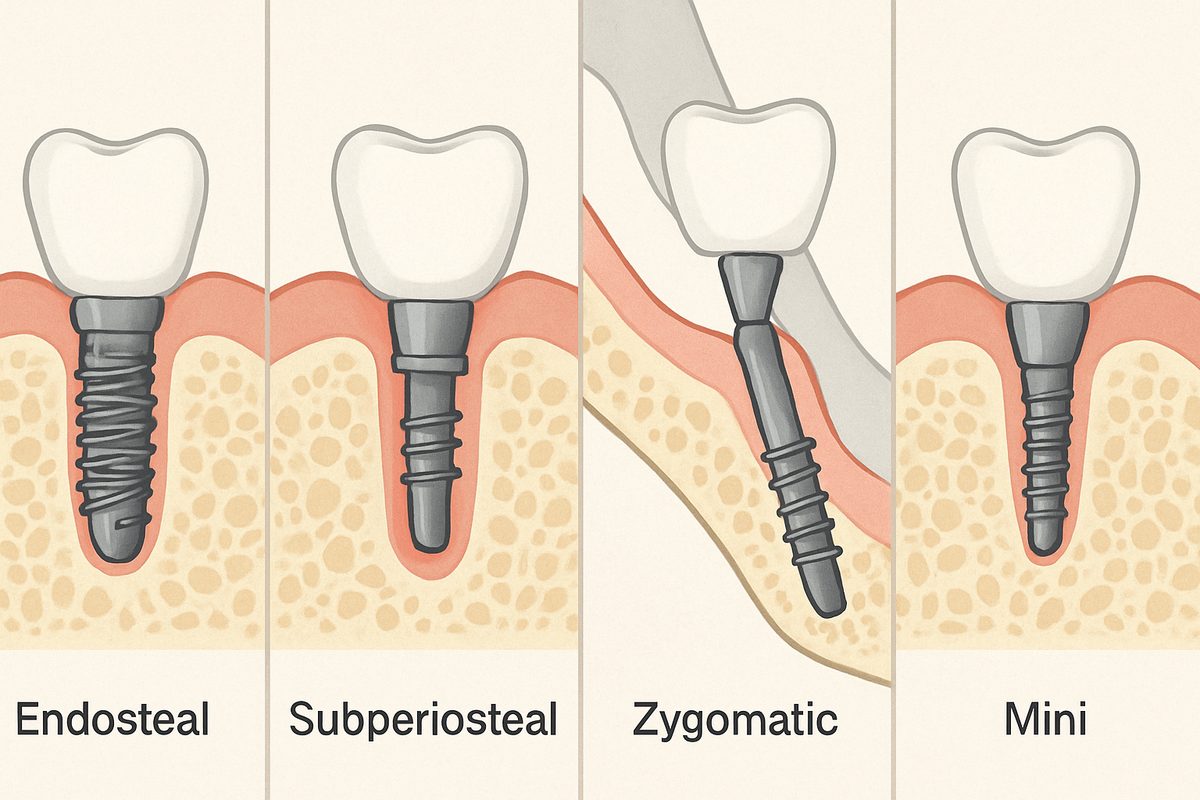
Dental implants are artificial tooth roots that replace missing teeth and securely hold crowns, bridges, or dentures. This post explains the different types of tooth implants, who they help, and how to pick the right option. If you’re researching different types of teeth implants in Cambridge, OH, or nearby, this guide will help you understand choices and what to ask your dentist.
What are dental implants?
Dental implants are small posts placed into the jawbone to serve as artificial tooth roots. Once healed, they support crowns, bridges, or overdentures. Implants are often preferred over traditional bridges or removable dentures because they protect bone, feel more natural, and don’t rely on adjacent teeth for support.
Main categories of different types of tooth implants
Endosteal (standard) implants
Endosteal implants are the most common. They are screw-shaped posts placed directly into the jawbone. Ideal for single-tooth replacement or multiple teeth with individual implants. Pros: high success rate, natural function. Cons: need sufficient bone and healing time. Best for patients with good bone volume and overall health.
Subperiosteal implants
Subperiosteal implants sit on top of the jawbone, but below the gum line. They’re used when bone height is low, and patients want to avoid extensive bone grafting. Pros: avoids grafting in some cases. Cons: less common today and may have higher complication rates. Best for patients who cannot have standard implants without major bone work.
Zygomatic implants
Zygomatic implants anchor into the zygomatic bone (cheekbone) for patients with severe upper-jaw bone loss. They are longer and used when traditional implants are not possible. Pros: Avoid long grafting timelines and can support full-arch restorations. Cons: complex surgery requiring experienced surgeons.
Mini dental implants
Mini implants are narrower in diameter. They’re often used to stabilize lower dentures or in tight spaces. Pros: less invasive, faster recovery, lower cost. Cons: not as strong for large biting forces and not ideal for all cases.
All-on-4 and full-arch zirconia fixed bridges
All-on-4 uses four strategically placed implants to support a full-arch prosthesis—often with immediate function. Full-arch zirconia fixed bridges (like Prettau) are durable ceramic options for a natural look and long-term strength. These are options for patients who need a complete arch replacement.
Implant-supported crowns, bridges, and overdentures
Restorations attach to implants: single crowns replace one tooth, implant bridges replace several without using nearby teeth, and overdentures snap onto implants for stability while remaining removable. Choice depends on the number of missing teeth, budget, and maintenance preferences.
Materials: titanium vs. zirconia
Titanium is strong, well-proven, and integrates with bone. Zirconia is metal-free, more aesthetic for thin gums, and may suit patients with metal sensitivities. Both are reliable; the choice depends on aesthetics, tissue response, and clinical needs.
How dentists decide which of the different types of teeth implants is right for you
Dentists assess bone volume/density, number and location of missing teeth, medical history (smoking, diabetes), aesthetic goals, timeline, and budget. Digital planning and scans help determine which standard, zygomatic, mini, or full-arch solution is best.
Treatment timeline, cost drivers, and recovery
Typical steps: consultation and scans, implant placement (sometimes same-day provisional teeth), healing (weeks to months), and final restoration. Costs rise with bone grafts, extractions, the number of implants, and premium materials like zirconia. Recovery usually includes mild swelling and a few days of a soft-food diet.
Questions to ask your implant dentist
Ask about their experience with specific implant types, success rates, guided surgery, digital planning, same-day options, cost breakdown, financing, and warranty/aftercare.
About Woodlawn Dental Center’s implant care
Woodlawn Dental Center in Cambridge, OH, offers guided implant surgery, CEREC one-visit restorations, and Prettau zirconia fixed bridges. The team uses digital workflows and experienced doctors to plan predictable implant care for local patients.
Next steps: schedule a consult
If you’re exploring different types of teeth implants in Cambridge, OH, schedule a consult to review options, costs, and a personalized treatment plan. A visit can clarify which implant type fits your needs and timeline.